Saturday, August 15, 2026

Steeks: The Crocheted Reinforcement


A steek is a bridge a ‘bridge’ of stitches over what will later become an opening for an armhole, cardigan front or neck. The purpose of a steek is to enable knitting in the round, thus staying on the right side, rather than having to knit back and forth with purl stitches on the wrong side. This is particularly useful when doing colour work or complex designs. The steeks are later cut up the centre, leaving a seam.

Don’t be daunted by the cutting. Everyone will tell you that it’s easy and that you’ll never look back, because it’s true. You will never look back, having tried it once.

Whilst knitted cloth unravels across the rows, rather than down the columns, slippery yarns will still fray and need to be dealt with before cutting.

Note: with sticky Shetland or Scandinavian type wools, you can felt the steeks or simply make a running stitch either side of the centre column before cutting, or do nothing at all until the garment is complete.
Search in the labels 'Glossary', 'Tutorials' or 'Knitting' or go HERE to see the post on Steeking With Sticky Wool

The crocheted method is to make a chain along both sides of the central stitch. It's drawback is that you make a slightly bulkier seam, which can be averted somewhat by using a finer yarn than in the garment.

I have added 7 steek sts.

The reinforcement line is made through one leg of the centre stitch (column 4) and one leg of the stitch beside it (column 3 or 5). That is, you crochet together half of the centre stitch and half of the adjacent stitch, with the hook pointing into the centre as shown in the diagram above.

To secure the beginning, make a slip knot, then pop it on the hook. Put the hook through at position (5), then wrap the yarn around so you encompass the cast on edge. Hook it through the slip knot, making the first chain stitch. Now, following the arrows, slip the hook through one leg of column (5) and 1 leg of the central stitch (4), wrap the yarn around and pull it through. Continue up the column, with the hook pointing towards the centre as you see on the diagram.

When you reach the top, catch the cast-off edge.

Cut the yarn with enough tail to sew in and pull through the remaining loop to secure. Turn and repeat down the other side.

The centre steek stitch now has been reinforced, with half of it in each row of crochet. When you pull these rows apart a little, you will see a ladder between them. With care not to snip the reinforcement, cut through this ladder.

Trim or tidy excess after blocking. Once the sleeves are finished, you can stitch the seam in place, being careful to allow room for movement and not stitch through to the right side. For this, a light whip stitch will suffice.

Note: You could work the crochet lines one column across on each side, to give a narrower seam. Pick up one leg of column 6 & 5 or 2 & 3 instead, leaving column 4 free. You will still cut up the middle of column 4, then trim what will be a little more debris, after blocking.

Steeking With Sticky Wool

A steek is a ‘bridge’ of stitches that joins what will later become an opening for an armhole, cardigan front or neck.  The purpose of a steek is to enable knitting in the round, thus staying on the right side, rather than having to knit back and forth with purl stitches on the wrong side. This is much easier when knitting colour work.

With Shetland or Scandinavian, or any other sticky wools, you can felt the steeks, simply make a running stitch either side of the centre column (down positions 3 & 5) before cutting, or... do nothing at all until the work is complete, as I do. 

A super wash or otherwise slippery yarn will need extra reinforcement and I will add a post titled: The Crocheted Steek Reinforcement. Look in labels under glossary, tutorials, knitting or crochet.

Column 4 (above) is the beginning and end of a new round (you can see the jog in the photo, below left). I join my yarn here and may end up with a lumpy stitch of 4 strands. Otherwise, it is the darker of your colours. Switch from dark to light to dark as shown, giving you a darker edge column on each side of the steek. This makes it easier to distinguish the steek from the garment and makes a distinct line to follow when picking up stitches.

If the steek is for a sleeve and the shoulders are grafted together, include the steek in the shoulder graft, folded at the arrows so that columns 1 & 7, 2 & 6 and 3 & 4 are grafted together, with the centre steek (grey arrows on diagram or red at left) set aside on a stitch holder.

Some prefer to cut the steek before picking up new stitches and this may be easier at times. I tend to pick up along one side, then cut the steek to make picking up down the other side easier. 

To cut the steek, carefully snip up the middle of column 4. That is, cut the column in half lengthwise. All of your joined ends will either fall away or can be trimmed, which means there is no need for sewing in along a steek. Yay!

Having 7 steek stitches, rather than 5, gives a little wiggle room for neatening. Half of the next columns (3 & 5) will also be trimmed away, later.

Use the edge steek stitch to pick up new stitches for the sleeve or front button band, as shown on the diagram. Note: Pick up 1 stitch for every row, with adjustments/decreases made on the first row of knitting or ribbing. This makes a smoother seam than if you were to pick up 3 then skip one, for example.

Steek with Herringbone stitch: Once the sleeves or bands are finished, trim the steek back to the centre of column 3 or 5. Don't trim too far ahead of your stitching (to avoid fraying): 

Thread a needle with fine yarn or thread in a similar colour and secure, without going through to the fronts. Working from left to right, take a little back stitch (or scoop) along top line (1 to 2), then another along bottom line (3 to 4), in repeat, with the trimmed seam inside. You can press it flat with your fingers. Continue in this way, tucking in the trimmed raw edge as you go. This method is neat, elastic and sits flat. The seams blends into the fabric and will hardly be noticeable.

If, however, you have an unsightly machine-sewn reinforcement as I needed on this adaptation of Alice Starmore's 'Thoroughbred', or just want to hide the seam, you might like to sew a ribbon down the inside as shown. Again, be careful not to stitch through to the front and allow room for a little stretch. A finer Herringbone stitch is still a good option.

Saturday, August 01, 2026

Geansai Gaelach - An Irish Jumper. My First Ever Garment Knitting Pattern is Live. 19 sizes.

The GeansaĆ­ Gaelach pattern is inspired by an exquisite Aran gansey, or geansaĆ­, held at the National Museum of Ireland (obtained 1942). Showcased in the ‘Is Fashion Modern?’ exhibition at New York’s Museum of Modern Art (2017) and in the ‘Changing Ireland’ gallery in Dublin’s Collins Barracks (2025), it was and has remained an iconic representative of the Aran style.


The fishermen and the Herring Girls took their knitting wherever they worked. In this way the gansey style spread and developed all around the British Isles and Ireland from around the 19th Century. The all-over combination of central panels, bobbles and cables that we now recognise as the Aran style, developed as recently as the early 1900’s in Ireland and has a well-documented history. Borne of the old ganseys, the Aran style became and remains colloquially Irish.


“The jerseys that the women knit are white or indigo... and on these square shaped garments they improvise, as a musician will improvise on some simple melody, their own individual fancies. There are circles and ellipses and zigzag lines and dots like a chain of pearls, and loops and lovers’ knots and lines like rippled water”.


This design is compiled by adapting just a few of the original motifs. It is an homage to the Ireland of my ancestors and to the knitting traditions I am so fortunate to have inherited through my mothers and grandmothers.


Geansai Gaelach is made using 5 ply (sports weight) Propagansey Corriedale wool. It comes in 19 sizes from (a): 47 cm to (s): 178 cm chest. Adult sizes are given in both female and male proportions.


The children’s sizes broadly equate to: 

(a): 0 to 6 months, (b): 6-18 months, (c): 1 to 2.5 years, (d): 2 to 4 years, (e): 4 to 6 years, (f): 6 to 8 years and (g): 8 to 10 years.

Sizes: (a to g): 240(280,330,440/520,640,760) metres. 

Sizes (h to s): Women’s:(930/1030,1130,1230,1360/1480,1640,1840,2070/2290,2450,2630)metres & Men’s: (1020/1150,1245,1300,1480/1640,1830,2030,2285/2520,2680,2860) metres.


Gauge: 28 sts x 36 rows = 10 cm.

Needles: 3.5 & 2.75 mm circular or double pointed needles and cables to suit (or those to obtain gauge).

Available at my Etsy store or at Ravelry. All sizes are within this pattern.


 This is the original, held at the National Museum of Ireland. Link HERE to a lovely story about Aran knitting.

Thursday, January 04, 2024

Bobby La’s Hand Dyed Yarns Launch


I have just put up the first of my Australian Merino hand dyed and natural yarn on Etsy (via bio). The labels aren’t quite printed yet (ink is still wet on the garden drawing, which has nothing to do with wool but everything to do with home).     This is a gorgeous, soft, strong, lightly lofted 17 micron, 1/13nm (100g/1,300m)merino that takes colour beautifully. Colours will build and you can order any amount, but this is for my fun, on top of a job and a wild idea to write a book of my own designs (2 years in and well on the way).                                         

I just love this wool so much and want to share it in either it’s natural state or colours that I love, true story. Note @elizabethwilliamsonknitting ‘s #daskelberryshawl knit by @sk2pgrant and dyed by myself. So grateful!! #bobbylashanddyes #handdyedyarn #cobwebwool #finelaceknitting #shetlandlace #knittersgonnaknit #shetlandknitting #australianmerino #beautifulhanddyedyarn #cottageindustryaustralia #robynemeliaisbobbyla #illustrationartists #inkdrawing #topiarygarden #topiarybirds

Friday, September 22, 2023

The Widow’s Lament


 I’m looking at the dent on the couch

Where you used to sit

It’s still there

I’m thinking of the dumb
Arse
Crap
I (can) watch
Without your eyes

Rolllling

Without some groaning

Without even watching (I’m busy)
(I don’t care)

Without you
Now you’ve gone
I might end up watching the wrong shows

All of the time

I miss you

Friday, July 28, 2023

Alexander Kenneth Tolmie McKenzie & Jane (Jennie) Ross, His Wife.


Thought to be a tall red-head.

Alexander McKenzie, born 5 Dec 1842 in Fodderty, to Kenneth McKenzie and Ann (Annie) Tolmie & Jane Ross, born 30 Dec 1842 in Ardgay, Kincardine, to Donald (Callum) Ross and Ann (Annie) Murray.

The gorgeous book: 'The Chronicles of the Ardchronie Children: Parish of Kincardine' has a beautiful account of Jane (Jennie)'s parents Donald Callum and Annie's wedding and then Jane's birth (both below). Note that Maggie, the author, is Jane's younger sister. More about Donald later.

Alexander & Jane married 28 Nov 1864 in Dundee. He was a Mason and she a domestic servant. It's the first time just now that I noticed they were at the same address and that it's a fair way from home. 3hrs drive today. I suppose that's where they met.

The very next I hear from them is via the birth of their son, named Alexander (of course) born in Shellback Creek, Thames, New Zealand in 1869. Our Alick by now a miner. You will no doubt be aware of the gold rush going on in NZ and Australia. In 1872 my great grandmother Elizabeth (Bessie, no one was allowed to call her anything but Bessie) McKenzie was born in Thames, New Zealand (North Island). Alick was by now a contractor.

The family moved to the Dunedin area on the South Island, though I'm not sure when or what was happening. There is the Deborah Bay tunnel contract in 1874 and Jane much later lived at Palmerston nearby. I assume the family were around Dunedin for much of the time while Alexander travelled for work. The contracts include Alick's brothers Daniel and John. Daniel did aged 51 in 1890.

I had not known of Daniel as he was not present for the 1851 census, however family contacted me to inform me of Annie nee Tolmie (of the wedding story) going to NZ and sent this gravestone picture below. A Daniel McKenzie is found at another property in Tain, as a stable boy (aged 14) and I imagine it was not a terribly common name and explains the gap.


Port Chalmers, New Zealand.

 On 5 Dec 1878, in Greymouth, Alexander was struck and killed by a 'lodger' when felling a tree. See article below. 

Alexander was part of the Freemasons in Thames. His name is found in their archives and below, the obituaries speak of his character. There are mistakes. For example I have no evidence of the couple ever going to Nova Scotia, though I have no travel records at all so they may have popped over. Alick's brothers John and Daniel McKenzie were over in NZ too. Daniel shows up at a nearby place in the census in Scotland and I had not otherwise known of him, until finding some distant family who confirmed via Ann Tolmie's death. After their father Kenneth McKenzie died in Scotland, Annie followed them down to Dunedin, NZ. I had imagined Alexanders life in NZ to be a lonely one, dying away from his wife and children. However I have found evidence that his brother Daniel had worked nearby not long before his death. With their mother Annie around, Jane, the children, her brother in laws and their families nearby, it will have been quite a family.

John, Daniel and Alexander had the contract for the Deborah Bay tunnel, a railroad tunnel that I think exists today as a walking track. 

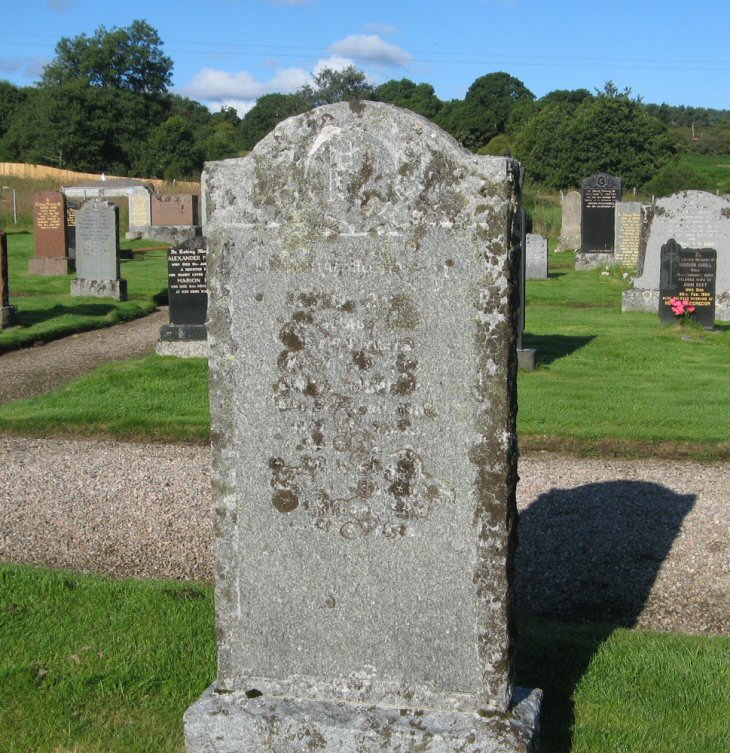
Jane's father Donald Ross was a road contractor back in Kincardine, where he lived his whole life as far as I can see. He is buried with Ann and their son John at Kincardine Cemetery (below).

5th December 1842, birth of Alexander McKenzie to Kenneth and Anne nee Tolmie.
Jane Ross, daughter of Donald Ross, Ardchronie, and Ann Murray. b 30 Dec 1843, baptised 12 Jan 1844.

The wedding of Donald (Callum) Ross and Anne Murray (Jane's parents and Alexander's in laws).
 Beginning, My father... which is Donald Callum Ross (my g.g.g.grandfather). Near the bottom when the author states: Now for our family... there is mention of Jennie being in NZ ... this was such a moving passage to read and I am amazed to find such detail. Nice stories too.

The wedding certificate of Alexander and Jennie (Jane).

In New Zealand, in 1869 and 1872, Alexander and Elizabeth were born. Father, miner. The district they were born in was a huge gold-rush area. Elizabeth died before I was born but was quite a character. I'll do a separate article on her later.


Bessie's original birth certificate.

 Bessie joined the Salvation Army in Auckland and came to Melbourne, Australia, to study, where she met and married George Armstrong and had five children: Hazel, Laurel, Hilda, George (known as Keith, my gramps) and Ian Alister (Alec). Just a brag... Hilda and Laurel won a competition in 1923, choosing the name 'Vegemite' for a new vegetable extract you may have heard of (yum). 

Whilst I do have two of the contracts involving the Deborah Bay Tunnel, they are too long (and a bit boring) to add here. I did find this snippet from 1874 and imagine it to be my great, great grandfather, though I know nothing more on the subject:


And then, sadly, we go to his death. This was very difficult to find as the name is so common and NZ BMD doesn't have parents names in their search engine. However, I was contacted by someone who was related to Jenni's second husband (the name change being the reason I could not find her death certificate, nor any trace of her). That wedding certificate, whilst having Alexander  wrongly named 'Charles', added up in every other way and gave the date of this, her first husband's death, some 11 years previous. From that I was able to narrow down my search and find my grandfather's death certificate and then found a few newspaper articles.


I have not found any Nova Scotia connection though as mentioned I have no travel documents at all. He certainly was born in Scotland. 

The children were 6 & 9 years old. 
Young Alexander became a fisherman like his own father in law. I have yet to find any current descendants. He had 2 daughters and a son (Alexander of course) to Emma Ajen, his wife. One girl Annie Emma and Violet Jane. Annie died aged 14.


Jennie and John Shearer Ritchie's wedding. Note Jane's parents. They had no children (she was 45).

Below is the tombstone of Jane's parents and brother at Kincardine, Scotland. Donald Ross, the Road Contractor my father spoke of as having either been in NZ or being somehow connected to Alexander (his son in law) become a rail tunnel builder. I have no information about any link between their work and it's clear that Donald lived and died in Scotland, though 10 years between census allows for some movement.


Jane (Jennie) Ritchie's death.
Again, as is common with death certificates, where the recording of information about the deceased is by those around them, some details are incorrect. 

Below is Jennie's parent's gravestone at Kincardine, Scotland.

In loving memory of/DONALD ROSS/died 14th Aug. 1909/aged 94 years/and of his wife/ANNIE MURRAY/died 24th April 1910/aged 85 years/also their son/JOHN ROSS/died at Ardcronie/8th March 1929/aged 83 years.